
5 Signs You Need a Custom Tire
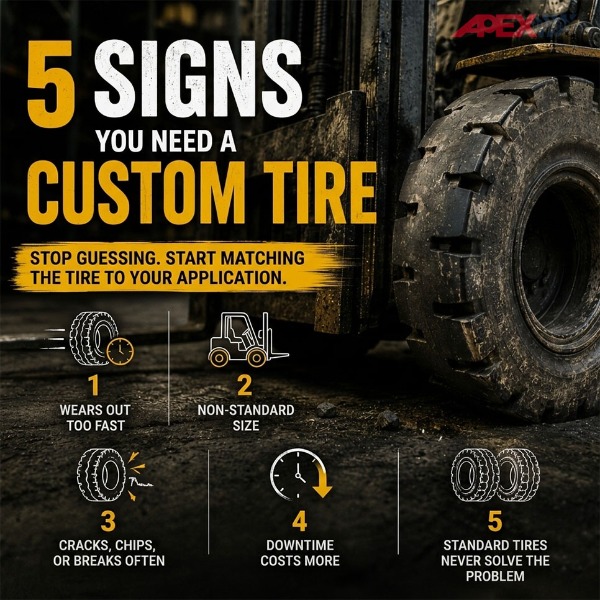
Stop Guessing. Start Matching the Tire to Your Application.
Not every tire problem is caused by poor quality.
Sometimes, the tire simply does not match the machine, load, or working environment.
If your team keeps replacing tires but the same problem comes back, it may be time to consider a custom tire solution.
1. Your Tire Wears Out Too Fast
If the tire wears much faster than expected, the issue may come from:
- rough ground
- sharp debris
- heavy loads
- long working hours
- wrong rubber hardness
A standard tire may work in normal conditions, but not in harsh industrial sites.
2. Your Machine Uses a Non-Standard Size
Some machines are not easy to match with regular tire sizes, especially:
- modified machines
- old machines
- imported machines
- special industrial equipment
- feeding or conveyor systems
When the tire size is hard to find, customization may be a better option than forcing an unsuitable tire to fit.
3. The Tire Cracks, Chips, or Breaks Often
Cracking or chunking usually means the tire is facing more stress than it was designed for.
Common causes include:
- high heat
- rough concrete
- metal debris
- uneven outdoor ground
- heavy impact
- chemical exposure
In this case, the rubber compound may need to be adjusted.
4. Downtime Is Becoming More Expensive Than the Tire
A tire may look “cheap” at first.
But if it causes:
- machine stoppage
- emergency repair
- delayed production
- extra labor cost
- missed delivery schedules
Then the real cost is no longer the tire price.
It is downtime.
5. Standard Tires Never Fully Solve the Problem
If you have already tried different suppliers, patterns, or sizes — but the problem keeps coming back — your application may need a more specific tire design.
Customization may include:
- special size
- different hardness
- special tread pattern
- stronger compound
- heat-resistant formula
- non-marking material
- application-specific structure
📌 Final Thought
Custom tires are not only for “special projects.”
They are often for real working sites where standard tires simply cannot handle the job.
If your tire problem keeps repeating, stop guessing.
Start with the application:
What machine are you using?
What ground condition?
What load?
What temperature?
What problem happens most often?
The better we understand the working condition, the better tire solution we can suggest.