
Beyond Tires: How Rubber Liners Protect Chutes, Hoppers and Transfer Points
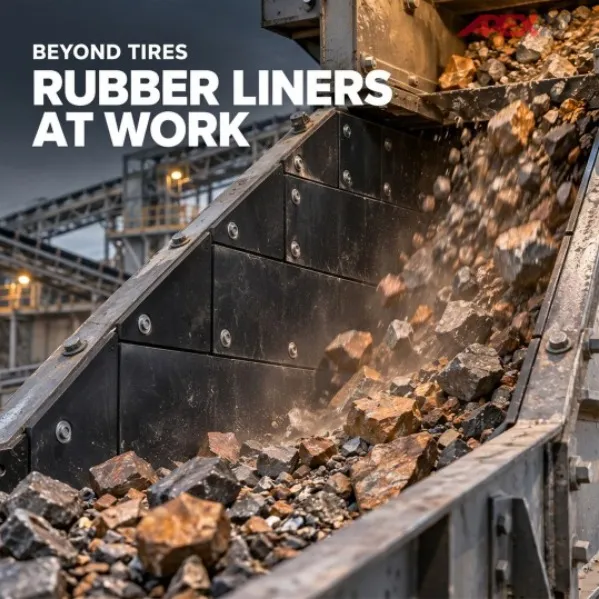
Every load of ore, stone or metal scrap creates impact and abrasion inside chutes, hoppers and transfer points. Over time, the steel surface becomes thinner, noise increases and unplanned maintenance becomes more frequent.
This is where rubber wear liners can help. 🛡️
Rubber Liners vs. Steel Plates
Steel plates provide strong structural support, but repeated impact from heavy material can dent, crack or wear the surface.
Rubber liners react differently. Their elasticity helps absorb impact energy and reduce direct contact between the material and the steel structure. They can also lower impact noise and protect the equipment underneath.
However, rubber is not automatically the best choice for every application. Sharp scrap metal, very high temperatures or severe sliding abrasion may require another material or a combined rubber-and-steel design.
Harder Is Not Always Better
The right rubber hardness depends on the application.
A softer compound may absorb impact more effectively, while a harder compound may offer better resistance to certain types of abrasion. Material size, shape, drop height, speed and moisture must all be considered.
The same principle applies to thickness. A thicker liner may look more durable, but it can also reduce the internal opening, disturb material flow or create unnecessary weight.
Effective liner design is about balance—not simply adding more rubber.
Different Equipment Needs Different Designs
Rubber liners may be supplied as:
- Flat liner sheets
- Curved or formed liners
- Modular impact panels
- Steel-backed rubber liners
- Custom-moulded sections
The correct structure depends on where the material first strikes, how it moves through the equipment and how easily the liner can be replaced during maintenance. 🔧
Before Requesting a Quote
To recommend a suitable liner, suppliers normally need:
✅ Material type and particle size
✅ Drop height and impact angle
✅ Operating temperature
✅ Wet or dry conditions
✅ Current liner material and service life
✅ Equipment drawings or installation dimensions
✅ Main problem: impact, abrasion, noise or material build-up
A well-designed rubber liner does more than cover steel. It helps control wear, protect equipment and reduce maintenance interruptions.
Have a difficult chute, hopper or transfer point? Share your operating conditions with us. Even if the application requires a special design, understanding the problem is the first step toward a practical solution.