

How Ambient Temperature Affects Solid Tire Performance
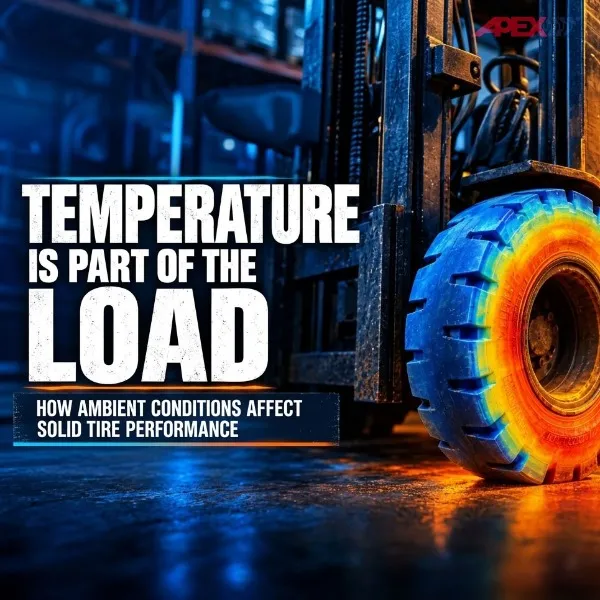
Solid tires are built for demanding operations, but ambient temperature can significantly change how they perform. From cold-storage warehouses to hot foundries, temperature affects rubber flexibility, heat dissipation, traction, and tire life.
🔥 High-Temperature Environments
Solid tires naturally generate heat as the rubber repeatedly compresses and recovers. In hot environments, this heat dissipates more slowly, causing the tire’s internal temperature to rise faster.
Combined with heavy loads, high speeds, long travel distances, or continuous operation, excessive heat may lead to:
- Accelerated tread wear
- Rubber softening or chunking
- Increased rolling resistance
- Separation between tire components
- Shortened service life
Ambient heat alone is rarely the only cause. The greatest risk occurs when high temperature is combined with demanding operating conditions.
❄️ Low-Temperature Environments
Cold temperatures make rubber compounds stiffer. This may reduce shock absorption and temporarily change traction, especially on smooth, wet, or icy surfaces.
Operators may notice:
- A firmer ride
- Reduced grip during startup
- Greater sensitivity to impacts
- Surface cracking in unsuitable compounds
- Condensation when equipment moves between temperature zones
Cold-storage applications therefore require tires with compounds suited to low-temperature operation.
🌡️ Temperature Transitions Matter Too
Forklifts moving repeatedly between cold rooms and warm loading areas experience thermal cycling. Expansion, contraction, and condensation may affect tire performance and increase the need for regular inspection.
✅ Temperature-Risk Checklist
- Record operating and floor temperatures
- Check load, speed, and travel distance
- Allow cooling periods during intensive shifts
- Inspect for cracks, chunking, or separation
- Clean debris from the tread and wheel area
- Confirm that the tire compound suits the environment
Choose Tires for the Real Operating Environment
Temperature should be considered together with load, speed, floor condition, duty cycle, and travel distance. A tire that performs well in a standard warehouse may behave differently in a freezer or foundry.
APEXWAY provides application-based solid tire recommendations for demanding industrial environments. Contact our team to identify the right compound and specification for your operation.