
How Tire Design Affects Traction in Agricultural Machinery
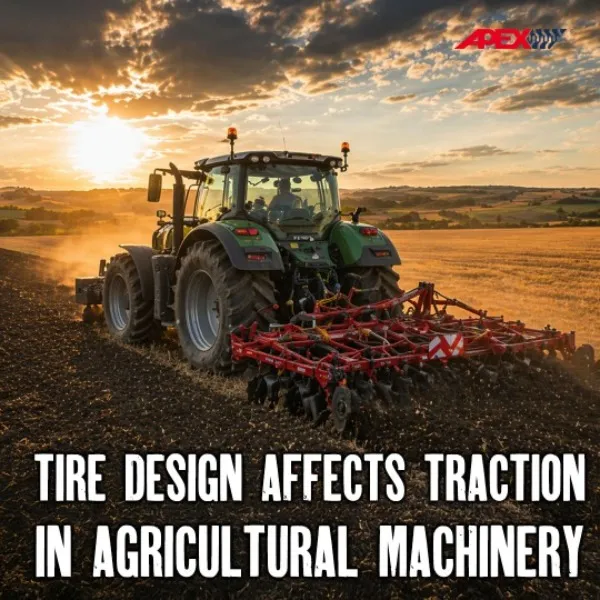
Traction is the tire’s ability to transfer torque into forward motion. When a tire slips, power becomes heat and surface disturbance instead of progress. Excessive slip increases fuel consumption and can damage soil structure.
A good selection balances traction with low soil compaction and predictable steering.
- Low slip improves fuel efficiency.
- Stable traction improves implement performance and consistency.
- Reduced compaction supports long-term yield.
Design factor 1: Tread pattern and lug geometry
Lugs act like paddles in soil. Their angle, spacing, and depth determine how the tire bites and cleans itself. Wide spacing helps in mud by ejecting material. Closer spacing can improve stability on firmer ground.
The best pattern depends on whether your field is soft, wet, or firm.
- Wet and muddy fields: prioritize self-cleaning lug spacing.
- Firm ground: prioritize stability and even footprint.
- Mixed conditions: choose a balanced pattern designed for versatility.
Design factor 2: Footprint and contact patch
A wider footprint spreads load and reduces ground pressure. This can reduce compaction and help traction by maintaining consistent contact.
However, too wide can increase rolling resistance and affect steering. The correct footprint is a match between load, soil strength, and work speed.
- If you see deep ruts, you may be overloading the footprint.
- If you see excessive slip, traction may be insufficient for the torque and soil condition.
Design factor 3: Carcass construction and sidewall behavior
Construction influences how the tire flexes and how stable it feels under load. In field work, controlled flex can improve contact. In road transport, too much flex can increase heat and wear.
That is why agricultural operations often require a tire that performs across both field and road.
- Long road travel: focus on heat management and stability.
- Heavy field work: focus on contact consistency and traction.
Design factor 4: Compound and wear balance
Rubber compound affects traction and wear. Softer compounds can grip better, especially on colder surfaces, but may wear faster on road segments. Harder compounds can improve durability but may reduce grip in wet conditions.
Selecting compound is a practical trade-off decision.
A practical selection checklist
Use this checklist before ordering.
- Equipment type and axle load: tractor, implement trailer, forwarder, or forestry application.
- Primary terrain: soft soil, mud, mixed, or firm ground.
- Time split between field and road.
- Primary goal: reduce slip, reduce compaction, improve durability, or improve stability.
- Past failure mode: sidewall damage, uneven wear, traction loss, or heat-related issues.
If you want a tire that fits your field conditions and work cycle, contact APEXWAY with your equipment model, terrain description, and typical load. We will help you define a specification that improves traction and efficiency.