

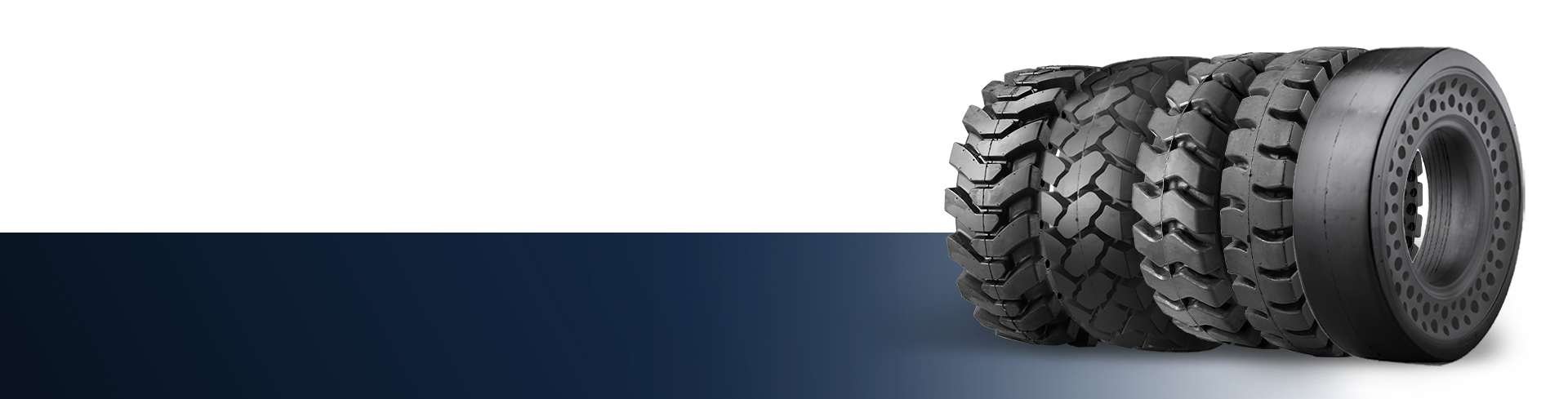
Press-On vs Resilient Solid Tires: Which One Is Right for Your Application?
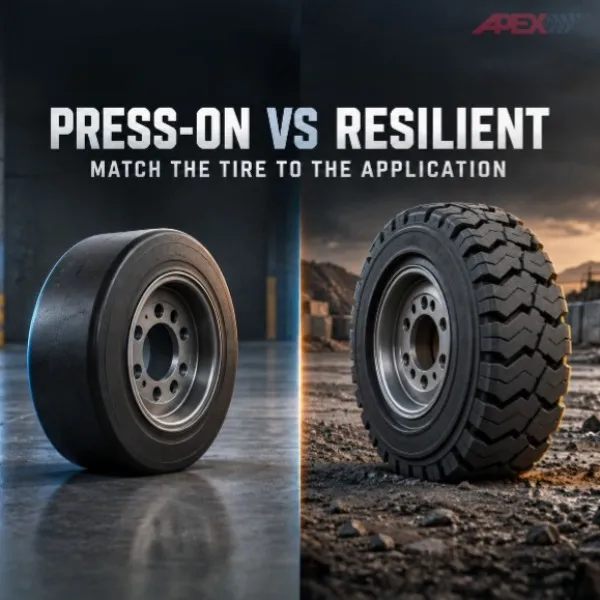
What Are Press-On Solid Tires?
Press-on tires consist of solid rubber bonded to a steel band and pressed onto a compatible wheel center.
Their compact profile provides excellent stability, precise handling, and a smaller turning radius. This makes them well suited for indoor applications where forklifts operate in narrow aisles or height-restricted environments. 🏢📦
Best suited for:
- Smooth, level indoor floors
- Warehouses and manufacturing facilities
- Short, repetitive travel cycles
- Applications requiring precise maneuverability
- Equipment designed specifically for press-on tires
However, their thinner rubber profile provides less shock absorption. Uneven surfaces, floor joints, and debris may increase vibration transferred to the forklift, operator, and load.
What Are Resilient Solid Tires?
Resilient solid tires have a deeper rubber profile designed to provide greater cushioning and shock absorption.
They can handle a wider range of operating conditions, including rough floors, outdoor yards, loading areas, and longer travel distances. Their larger diameter may also provide better ground clearance and obstacle-crossing capability. 🏭
Best suited for:
- Indoor and outdoor operations
- Rough or uneven surfaces
- Longer travel distances
- Applications where ride comfort matters
- Environments with joints, debris, or surface transitions
Their larger profile may require more operating space, so equipment clearance and wheel compatibility must be confirmed.
Quick Selection Checklist ✅
Choose Press-On when:
- Floors are consistently smooth
- Turning space is limited
- Stability and precise handling are priorities
Choose Resilient when:
- Surface conditions vary
- Vibration and operator comfort are concerns
- Equipment frequently travels outdoors or over longer distances
Make the Decision Based on the Application
Before selecting a tire, evaluate the surface, load, travel distance, speed, duty cycle, clearance, and wheel configuration. The wrong choice may increase vibration, tire wear, maintenance costs, or operator fatigue.
Not sure which solid tire fits your operation? Contact APEXWAY to review your equipment and working conditions before making the final selection.