
The Hidden Cost of Tire Failure in Construction Sites
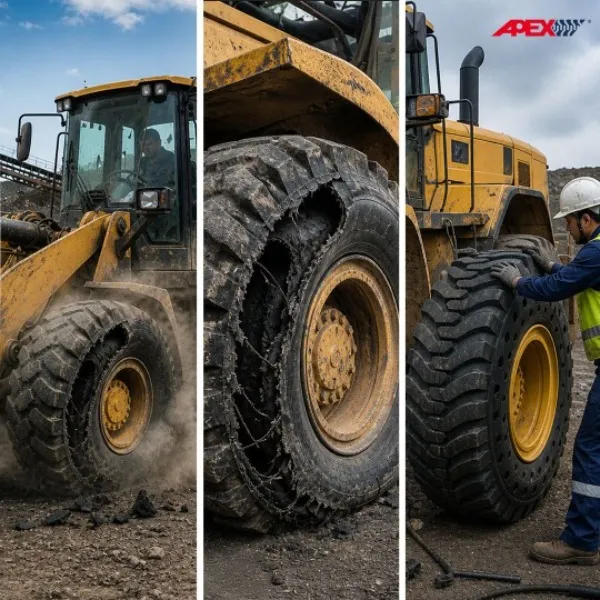
In construction sites, equipment downtime is often seen as an unavoidable part of daily operations.
A flat tire?
Fix it. Replace it. Move on.
But in reality, tire failure is not just a maintenance issue.
👉 It is a direct impact on your project profitability.
What really happens when a tire fails?
When a pneumatic tire fails on-site, the visible issue is simple:
→ The machine stops.
But what follows is where the real cost begins:
1. Equipment Downtime
A single tire failure can stop a machine for hours — sometimes longer depending on site conditions.
No movement = no progress.
2. Labor Idle Time
Operators, support workers, and sometimes entire teams are forced to wait.
👉 You’re still paying wages — but getting zero output.
3. Project Delays
Construction schedules are tightly linked.
One machine stop → multiple processes are delayed.
This can affect:
- Material handling
- Concrete pouring timing
- Equipment coordination
The cost nobody calculates
Most companies focus on tire price:
- Pneumatic tire: cheaper upfront
- Solid tire: higher initial cost
But very few calculate the real cost behind a single failure.
Example: One Tire Failure Scenario
|
Item |
Estimated Impact |
|
Equipment downtime |
3–6 hours |
|
Labor idle cost |
$150–$300 |
|
Equipment standby cost |
$100–$200 |
|
Project delay impact |
$200–$500 |
👉 Total hidden cost (per incident): $450 – $1,000+
*Note: The figures above are based on typical construction site assumptions and industry observations. Actual costs may vary depending on labor rates, equipment type, project scale, and site conditions.*
Now scale that to real operations
If your site experiences:
- 1–2 tire failures per month
- Multiple machines in operation
Then over a year:
👉 Hidden cost can easily exceed $10,000 – $30,000
*Note: This estimation is for illustrative purposes only and may vary depending on operational frequency, site complexity, and maintenance practices. *
Why this happens
Pneumatic tires are vulnerable in construction environments:
- Sharp debris
- Uneven surfaces
- Heavy loads
- Continuous operation
👉 Failure is not “if” — it’s “when”
The real decision is not about tires
This is where most decisions go wrong.
Companies compare:
- Tire price
instead of - Cost of operation
The real comparison should be:
|
Factor |
Pneumatic Tire |
Solid Tire |
|
Upfront cost |
Lower |
Higher |
|
Failure risk |
High |
None |
|
Downtime |
Frequent |
Minimal |
|
Maintenance |
Ongoing |
Low |
|
Total cost |
Unpredictable |
Stable |
What smart operators focus on
Leading construction operators don’t optimize for purchase price.
They optimize for:
👉 Operational continuity
Because they understand:
One hour of downtime often costs more than the tire itself.
Conclusion
Tire failure is not just a small incident.
It is a chain reaction:
👉 Downtime
👉 Idle labor
👉 Delayed schedule
👉 Lost revenue
Final Thought
If your equipment runs daily,
👉 This is not a tire decision.
👉 It’s a cost control decision.
Note
The cost figures presented in this article are simplified estimates intended to illustrate the potential financial impact of equipment downtime.
Actual results may vary depending on specific operational conditions, equipment usage, and cost structures.