
Why Airport GSE Tires Require a Different Standard of Safety
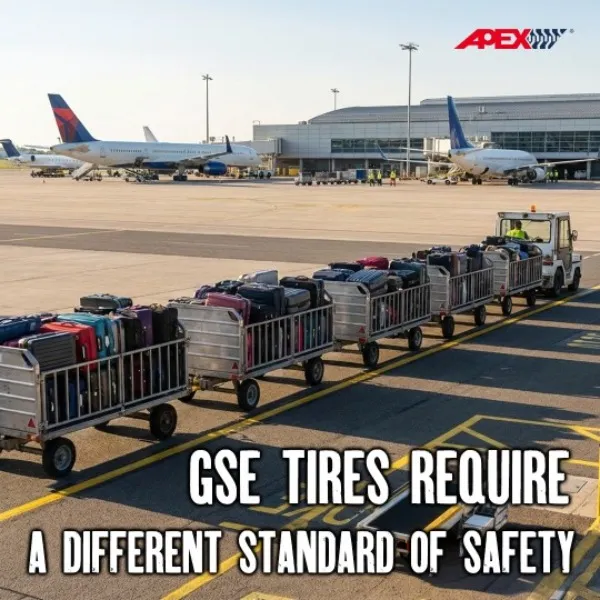
Airports are engineered systems. Every minute matters, every movement is tracked, and the tolerance for unexpected failure is close to zero. In this environment, ground support equipment depends on tires that deliver consistent stability, predictable braking, and long-hour endurance.
That is why GSE tires require a different standard than general industrial tires. Below is what makes them unique, where generic tires fail, and how to specify a safer fit.
What makes the airport environment different
Airport operations combine heavy loads, frequent stops, and tight maneuvering in controlled areas. Equipment may operate across varied surfaces including ramps, indoor bays, and outdoor service lanes.
On top of operational complexity, there is heightened scrutiny around safety and reliability. Tire-related instability can create cascading delays or safety incidents.
· High duty cycles: long operating hours with minimal cool-down.
· Precision movement: frequent docking, alignment, and low-speed control.
· Surface variation: indoor smooth floors and outdoor textured pavements.
· Safety oversight: procedures and checks are stricter than typical warehouses.
Why generic tires become a risk
A common cost-saving attempt is to use a tire designed for other industrial use cases. Sometimes it works in the short term, but the failure modes show up quickly under airport conditions.
Typical issues include accelerated shoulder wear during tight turns, vibration that affects alignment tasks, and inconsistent traction during wet conditions.
· Instability under load: small deflection differences matter when equipment carries passengers or cargo.
· Faster wear and higher replacements: spec mismatch shortens life even if the tire quality is acceptable.
· Compliance concerns: the wrong tire can create documentation and safety review issues.
Key performance factors to specify for GSE
Instead of shopping by size alone, focus on performance requirements and operating reality. A “fit” is a match between equipment, environment, and duty cycle.
· Load and duty cycle: typical load, peak load, speed, and hours per day.
· Turning pattern: tight turns, pivot points, and frequent dock maneuvers.
· Vibration tolerance: how much vibration the operation can accept for precision tasks.
· Wet and temperature conditions: traction and compound behavior in real weather.
· Maintenance preferences: balance between ride comfort, durability, and puncture risk.
Where customization adds the most value
Customization is not only for special sizes. It is for special operating conditions. Adjustments in compound, hardness, tread design, and construction can improve stability and reduce early wear.
In many airport applications, this is the difference between predictable maintenance and repeated surprise replacements.
· Compound selection for the right balance of grip and wear.
· Construction choices to support stability under repeated stop-and-go cycles.
· Design tweaks that reduce vibration and improve equipment control.
A practical checklist before you order
Use this checklist to avoid specification gaps.
· Confirm equipment type and application: passenger boarding bridge, baggage tractor, cargo loader, carts, or lifts.
· Document operating surfaces: indoor bay, outdoor ramp, mixed use.
· Estimate duty cycle: hours per shift and days per week.
· Identify failure history: where do current tires wear first and why.
· Define success metrics: fewer replacements, less vibration, safer handling, or improved traction.
If you share your equipment type and operating conditions, Apexway can recommend a GSE tire specification aligned with your safety and uptime priorities. Contact us to start a quick application review.
Links: