

Why Golf Cart Tires Wear Out Faster Than Expected (and How to Fix It)
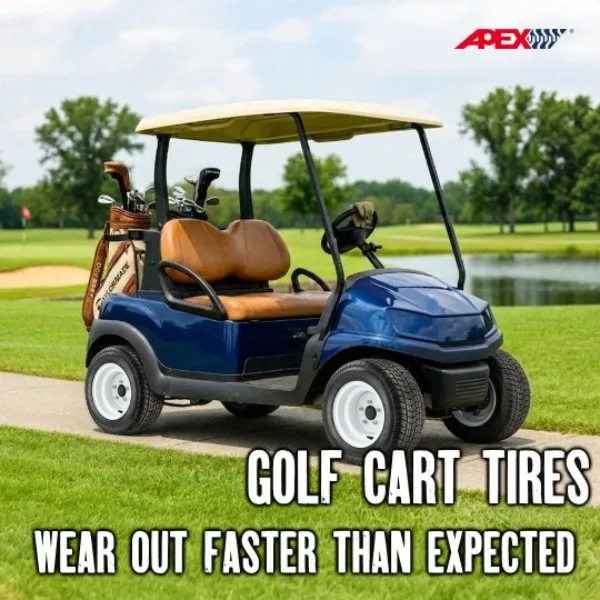
Golf cart and utility tires look simple, but their operating reality is not. Many carts carry more weight than intended, drive on mixed surfaces, or run under-inflated for long periods. The result is premature wear that feels inevitable.
It is not inevitable. Most fast wear problems come from a mismatch between tire specification and usage. Here is how to diagnose the cause and extend tire life without sacrificing ride quality.
Reason 1: Overloading beyond the real specification
Carts are often used for more than passengers. Tools, supplies, and trailers add load. Even if the cart moves, the tire may be operating beyond its optimal range.
When a tire is overloaded, the contact patch changes and heat builds. Heat accelerates wear and can damage the carcass over time.
· Measure your real load: include passengers, cargo, and any trailer tongue weight.
· Compare against the tire’s load rating at your typical pressure, not the maximum printed number.
Reason 2: Terrain mismatch
A tire designed for smooth paths will wear quickly on gravel, rough pavement, or uneven turf. Similarly, aggressive tread intended for traction can wear fast on hard surfaces.
Your surface determines your wear pattern. Edge wear often signals aggressive turning on abrasive surfaces. Center wear often points to over-inflation.
· List your top three surfaces: pavement, gravel, turf, or mixed.
· Match tread design to surface: smoother patterns for hard surfaces, more open tread for loose terrain.
Reason 3: Tire pressure is treated as “set and forget”
Under-inflation increases rolling resistance and causes shoulder wear. Over-inflation reduces the contact patch and can increase center wear while making the ride harsh.
Small pressure differences matter because cart tires often operate at relatively low pressures. A few PSI can change handling and wear.
· Check pressure monthly and before peak season.
· Standardize a pressure target by load: one number for light use and one for heavy use.
Reason 4: Alignment and driving pattern
If the cart pulls to one side or wears one tire faster, alignment or suspension issues may be involved. Frequent tight turns in the same direction can also accelerate uneven wear.
The fix is not always a new tire. Sometimes the tire is revealing a mechanical issue.
· Watch for consistent left-right differences.
· Inspect wheels and bearings if vibration increases or wear becomes irregular.
How to extend tire life with simple habits
A few habits create the biggest impact.
· Rotate tires if your setup allows it and wear patterns are uneven.
· Remove embedded debris (small stones, glass, sharp objects) during routine checks.
· Avoid long stationary periods under heavy load to reduce flat spotting.
· Store carts away from direct sunlight when possible to reduce compound aging.
Choosing the right tire for your cart or trailer
If your operation uses carts for utility work, prioritize durability and load capacity over the softest ride. If comfort is the priority and surfaces are smooth, choose a design optimized for low noise and even wear.
The goal is to choose a tire that matches how you actually use the cart, not how the brochure describes it.