
Your Environment Is Destroying Your Tires Faster Than You Think
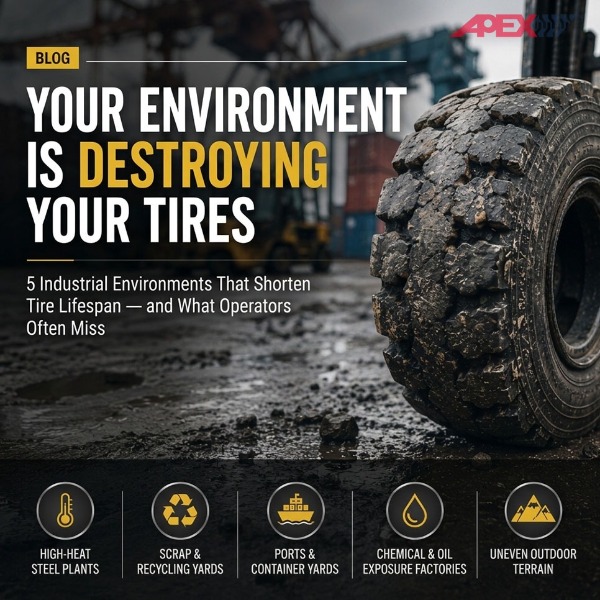
5 Industrial Environments That Shorten Tire Lifespan — and What Operators Often Miss
Why do some tires last 3 years in one factory… while the same tire fails within months in another?
Because in many industrial applications, the environment matters more than operators realize.
The same tire can perform completely differently depending on heat, ground conditions, debris, operating hours, and load intensity.
And in harsh environments, standard tires often fail much faster than expected.
1️⃣ High-Heat Steel Plants 🔥
In steel plants and high-temperature facilities, tires are constantly exposed to extreme heat and heavy workloads.
Common issues include:
- Rubber cracking
- Rapid wear
- Chunking
- Heat-related failure
In these applications, standard compounds may not provide enough heat resistance for long-term operation.
2️⃣ Scrap & Recycling Yards 🧱
Scrap yards are one of the harshest environments for industrial tires.
Operators often deal with:
- Sharp metal debris
- Uneven surfaces
- Heavy impact
- Continuous vibration
This can lead to:
- Tire cuts
- Sidewall damage
- Chunking
- Irregular wear
In these conditions, tread design and compound hardness become extremely important.
3️⃣ Ports & Container Yards 🚢
Port operations typically involve:
- Long operating hours
- Heavy loading cycles
- Continuous movement
- High operational pressure
While downtime may seem minor at first, tire-related stoppages can quickly become expensive.
In these environments, heat build-up and maintenance frequency often become the real operational cost.
4️⃣ Chemical & Oil Exposure Factories 🛢️
Some industrial floors contain:
- Oil
- Chemicals
- Solvents
- Contaminants
These substances can gradually damage rubber compounds and shorten tire lifespan.
Common signs include:
- Premature aging
- Softening rubber
- Surface deterioration
- Reduced durability
Some applications may require specialized rubber formulations designed for chemical resistance.
5️⃣ Uneven Outdoor Terrain ⛰️
Outdoor industrial environments often include:
- Rough terrain
- Gravel surfaces
- Slopes
- Muddy ground
These conditions can create:
- Uneven wear
- Excessive vibration
- Sidewall stress
- Reduced stability
In many cases, the problem is not the tire size itself — but the mismatch between the tire and the actual application.
The Right Tire Depends on the Environment
Many tire problems are not caused by poor quality alone.
In industrial operations, the working environment can dramatically affect tire performance, durability, and maintenance frequency.
That’s why more operators are starting to evaluate:
- Compound formulation
- Tread pattern
- Hardness
- Heat resistance
- Application compatibility
before selecting tires.
If your operation involves harsh or non-standard environments, it may be time to review whether your current tire setup truly matches your application.