
Solid Tires vs Pneumatic Tires in Port Operations: 3-Year Cost Comparison
In port operations, forklifts run almost continuously.
They handle:
- Heavy loads
- High-frequency movement
- Long working hours
When a tire fails, it is not just a maintenance issue —
it affects the entire operation.
Immediate impact includes:
- Slower loading and unloading
- Delays in vessel turnaround
- Idle labor and equipment
👉 Even one unexpected failure can disrupt the workflow.
The Real Cost Is Not the Tire
Many operations choose tires based on purchase price.
But in port environments, the bigger cost comes from:
- Unplanned downtime
- Emergency repairs
- Idle manpower and machines
👉 The real cost is lost operational time, not the tire itself.
Quick Comparison: Solid vs Pneumatic Tires
|
Item |
Pneumatic Tires |
Solid Tires |
|
Average Lifespan |
8 months |
24 months |
|
Blowouts per Year |
6 times |
0 |
|
Downtime Cost |
High |
None |
|
Maintenance Frequency |
High |
Low |
👉 Key takeaway:
Pneumatic tires can fail without warning.
Solid tires eliminate this risk.
3-Year Cost Comparison (TCO)
To understand the real financial impact, here is a simplified 3-year model.
Assumptions
- Forklift operates daily in port conditions
- Downtime cost = $150/hour
- Each failure = 2 hours downtime
- Pneumatic tire = $900 / set
- Solid tire = $1,200 / set
👉 Key Insight:
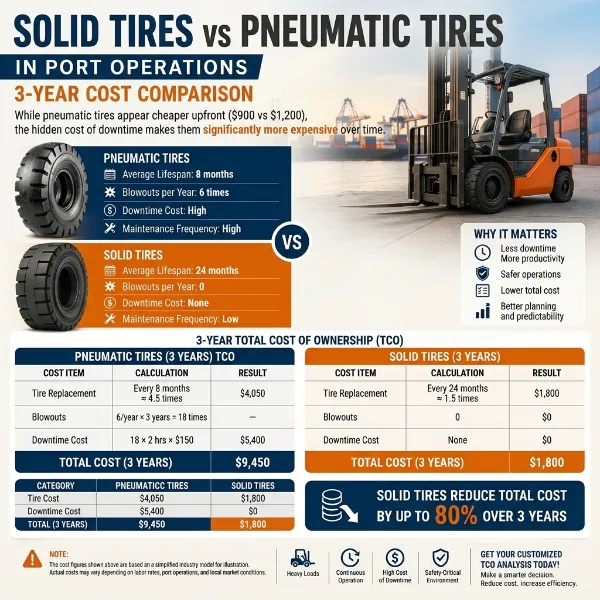
While pneumatic tires appear cheaper upfront ($900 vs $1,200),
the hidden cost of downtime makes them significantly more expensive over time.
Pneumatic Tires (3 Years)
|
Cost Item |
Calculation |
Result |
|
Tire Replacement |
Every 8 months ≈ 4.5 times |
$4,050 |
|
Blowouts |
6/year × 3 years = 18 times |
— |
|
Downtime Cost |
18 × 2 hrs × $150 |
$5,400 |
|
Total Cost |
$9,450 |
Solid Tires (3 Years)
|
Cost Item |
Calculation |
Result |
|
Tire Replacement |
Every 24 months ≈ 1.5 times |
$1,800 |
|
Blowouts |
0 |
$0 |
|
Downtime Cost |
None |
$0 |
|
Total Cost |
$1,800 |
Side-by-Side Cost Comparison
|
Category |
Pneumatic Tires |
Solid Tires |
|
Tire Cost |
$4,050 |
$1,800 |
|
Downtime Cost |
$5,400 |
$0 |
|
Total (3 Years) |
$9,450 |
$1,800 |
👉 Result:
Solid tires can reduce total cost by up to 80% over 3 years.
Operational Impact
Cost is only part of the picture. Daily operations also matter.
|
Factor |
Pneumatic Tires |
Solid Tires |
|
Replacement Frequency |
High (every 8 months) |
Low (every 24 months) |
|
Operational Disruption |
Frequent |
Minimal |
|
Planning Predictability |
Low |
High |
👉 Solid tires allow planned maintenance instead of emergency repairs.
When Solid Tires Make More Sense
Solid tires are the better choice if your operation has:
- Heavy loads
- Continuous operation cycles
- High cost of downtime
- Safety-critical environments
When Pneumatic Tires May Still Be Used
Pneumatic tires may still be suitable if:
- Terrain is uneven or off-road
- Load requirements are lower
- Downtime cost is minimal
Final Takeaway
In port operations, the real question is not:
“Which tire is cheaper?”
The real question is:
“Which tire reduces risk and total cost?”
👉 In most port environments, solid tires are not just a product — they are a cost control strategy.
Cost Assumption & Disclaimer
The cost figures presented in this article are based on a simplified industry model for illustration purposes.
They reflect typical operating conditions in port environments, including estimated downtime impact and average market price ranges for industrial tires.
Actual costs may vary depending on:
- Labor rates and local market conditions
- Equipment usage intensity
- Operational environment
- Supplier pricing
👉 For a more accurate evaluation, a customized cost analysis is recommended.
Get Your Own Cost Comparison
Every operation is different.
We can help you calculate:
- Your actual downtime cost
- Expected tire lifespan
- A customized 3-year cost comparison
👉 Get a simple TCO analysis based on your operation.